
Hormone Pellets
Hormone Pellets: Why You Should Avoid Them
What Are Hormone Pellets?
Hormone pellets are small implantable hormones, typically testosterone or estradiol, used in hormone replacement therapy (HRT). They are inserted underneath the skin of the hip with local anesthesia and slowly release hormones over three to four months. Hormone pellets were developed in the 1930s for women who received radical hysterectomies and have been used ever since to help relieve menopause symptoms.
What Are the Drawbacks?
While symptom relief sounds helpful, it’s important to understand the concerns associated with these tiny tablets.
Clinical studies for hormone pellet development were conducted on men to determine dosing. Men in the study received dosing every four to five months. This dosing protocol was directly applied to women, who have a different hormone therapeutic range and tend to need more frequent doses (about every 3 months).
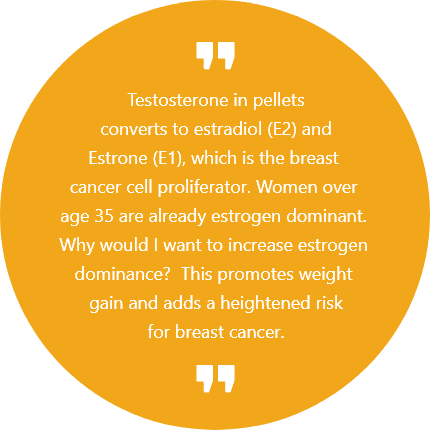
Since women have different thresholds for hormones, the pellets were found to increase levels of DHT (dihydrotestosterone)—a hormone often associated with hair loss—and/or estrogen-estradiol and estrone, which has been found to promote cancer cells.
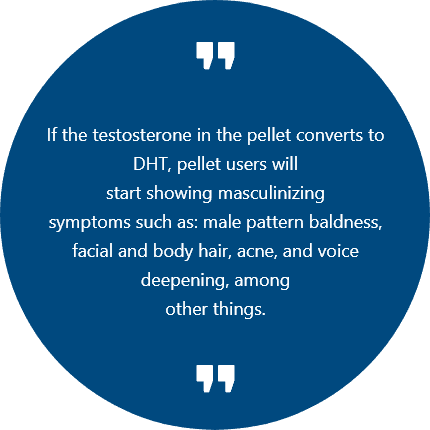
Some women’s bodies tend to convert the hormone pellets to estrogen, which can contribute to weight gain. Other women tend to convert the pellets to DHT, which can cause male pattern baldness, increased facial and body hair, acne, voice deepening, and other health issues. Unfortunately, once these symptoms show, they are hard to reverse.
The Problem with Too Much Testosterone
Most women who notice symptoms related to increased DHT do so after about a year of treatment, or around the third or fourth dose, while some notice hair loss and male pattern baldness side effects almost immediately. Sometimes, hormone pellets can lead to levels of testosterone that are much higher than normal female physiology, termed “supra-physiologic dosing.” The simple fact is that women’s bodies aren’t meant to metabolize all that testosterone.
Hormone Pellets Can Cause More Imbalance
After the body receives an influx of testosterone from the hormone pellets, it begins to convert some of it to estrogen. But 50% of women over the age of 35 are already estrogen-dominant. Why? Because around that age, progesterone—the hormone that helps balance estrogen—begins to decline. This means levels of estrogen can become elevated, causing further side effects like mood and breast changes.
Estrogen contributes to fat storage in the body, so elevated levels can contribute to weight gain. Additionally, estrone can be increased, which again is the estrogen-related hormone that can increase breast cancer risk. This means that women treated with hormone pellets can end up with out-of-whack hormones that impact their health and cause unwanted side effects.
Hormone Pellets Might Help… Until the Side Effects Kick In
Many women seem to do well after their first hormone pellet insertion. Because hormone levels often decline due to aging, hysterectomy, or postpartum changes, the first whopping supra-physiologic dose of testosterone may initially boost energy and raise libido. But after the second, third, or fourth implant, complications can arise. By this time, some women may develop significant hormone imbalances that impact sex hormones, and adrenal and thyroid function that require complex medical attention.
Hair Loss: A Real Concern
One of the major side effects of hormone pellets is hair loss and male pattern baldness. This can range from mild thinning to noticeable male-pattern baldness, and in some cases, almost complete loss of scalp hair. Most women will agree: their hair is a big deal! Hair loss like this can be extremely distressing.
Many times, women will turn to the healthcare practitioner who implanted the pellet for help with their hair loss, only to be told that their thyroid function or past hormone therapy is to blame. The truth is clear: when the body breaks down testosterone, it can turn into DHT, the hormone known to cause androgenic alopecia. High DHT levels can lead to significant hair loss, especially with ongoing use.
4 Steps to Take Now

Stop receiving hormone pellet insertions. The implanted hormones will gradually decrease over a few months.

Purchase Saw Palmetto supplements and take 2 capsules once a day. This helps stop the conversion of testosterone to DHT.

Purchase Biotin supplements to help promote new hair growth and take 1 capsule once a day. You can take these 2 supplements together.

Find a viable functional medicine facility, like my Happy Hormone Cottage, that is well-versed in optimal hormone balance and does not promote pellets as part of their approach for women’s health.
Blood Tests are Not Enough
Many doctors who use hormone pellets rely only on blood tests to decide on dosing and when to repeat insertions. But blood tests alone provide a limited snapshot of hormone levels at a single moment. They miss important information that blood tests cannot show, such as how hormones are used in the body, how active they are in tissues, and how the endocrine system is actually working.
A more complete look at hormone levels and how they are processed in the body is necessary for the whole picture.
At Happy Hormone Cottage, we perform a thorough evaluation that looks at levels of cortisol (the “stress hormone”), especially how they change throughout the day, and thyroid function. We use a 10-point blood panel to evaluate thyroid levels. (Read more about this on our Thyroid Health page.)
The Happy Hormone Cottage Can Help!
Happy Hormone Cottage was founded in August 2009, in the heart of Centerville, Ohio, as a safe place for women to be heard, validated, and educated in all things natural hormone balance. Why? Because we understand firsthand what it’s like to experience hormone changes, the disruption it can have on life, and the dismissiveness from doctors who just don’t understand. Some providers receive only a few hours of training on hormone education in medical school, so it is no wonder most are not well-versed in optimal hormone balance.
Our motto is “Get Tested, Get Treated, Get Better.” Over time, we built a reputation as a center that offered attentive care, clear education, and options for achieving real results for hormone balance. Today, we have two locations in the Cincinnati-Dayton area and have developed a fully integrated medical model, including a medical director, nurse practitioners, and Compounding Pharmacy. This allows our clients to move successfully from consultation and at-home testing to a personalized treatment plan, with custom therapies shipped directly to their home.
What Makes Our Approach Different
Unlike pellet-based and many other hormone treatments, Happy Hormone Collage uses personalized doses of compounded bioidentical hormone creams. Each cream is made to fit the patient’s needs, instead of using higher-than-normal doses. We don’t believe in supra-physiologic dosing. This approach matches the body’s natural chemistry and helps support safer, more balanced results.
Effective hormone care helps to balance estradiol, progesterone, and testosterone. Treatment usually starts with a progesterone cream, as this form is better absorbed by the body than oral capsules. Estrogen is not given to women who still have regular periods. Hormone levels are checked with advanced dried-urine tests, and personalized bioidentical hormone creams are made based on each patient’s results, including any adrenal findings. Doses are adjusted over time, with follow-up at three months and then checked yearly or as needed to keep hormones in balance.
Healthy Hormones for Life
At Happy Hormone Cottage, we understand our focus is not only on eliminating hormone imbalance symptoms but also on disease prevention. Research shows estrogen performs over 300 jobs in our body. Two of the most important are protecting the brain from dementia and the heart from heart disease. Progesterone balances estrogen to help prevent breast cancer. Testosterone signals the body to build strong, new bone, supports memory recall and energy, and, when healing tired adrenal glands, it can boost libido. Isn’t this the point of BHRT, or bioidentical hormone replacement therapy—to refill hormone receptors that decline with age, so we can focus on a higher quality of life, prevent disease, and ultimately restore and maintain wellness?
We are often asked, “How long should I use my hormone creams?” Our response is always, “For life!” As we age beyond 35, and our bodies lose the ability to make the hormones we need, why not continue to use them for the rest of our lives? This just makes sense to maintain a high quality of life.
Schedule a Consultation and Start Recovering from Hormone Pellet Therapy
To schedule a consultation, please call us at (513) 444-6343.
Schedule an Appointment Complete the form below, and we’ll get back to you right away.